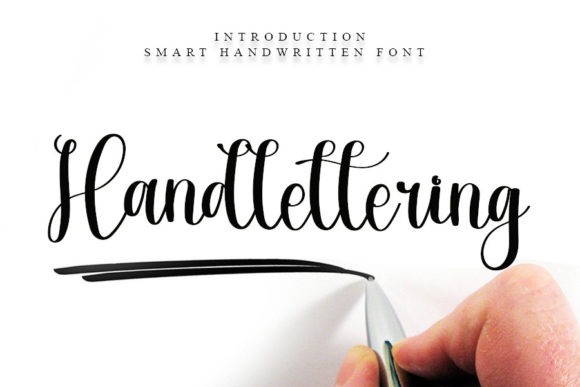
Handlettering: A Sweet Handwritten Font for Makers and Creatives
I found myself staring at a fresh batch of soy candle tins, completely uninspired by the crisp sans-serif labels I had been using for months. They were clean, sure, but they lacked the warmth and personality that my handmade products deserved. I wanted something with a gentle, hand-pulled look — something that felt like a note from a friend, not a factory imprint. That’s when I tested Handlettering on a simple oval label design, and the entire energy of the candle shifted. What had been a plain white tin suddenly felt like a boutique gift, something someone would reach for on a shelf. Handlettering is exactly what I’d been searching for — a script handwritten font that carries a sweet, delicate charm and an almost audible whisper of romance and joy.
This font has a distinct visual personality: the strokes are fine and dainty, the curves feel lighthearted, and the overall movement suggests a hand that was smiling while writing. There’s a natural variation in the letterforms that never looks messy or rushed, but instead reads like thoughtful, careful penmanship. For crafters, printable creators, and small shop owners, that kind of emotional quality isn’t just decorative — it transforms how a product is perceived. Because Handlettering leans into a soft, joyful aesthetic, it immediately elevates materials that need a personalized, human touch. It’s not a formal calligraphy font with heavy swashes, nor is it a bouncy modern script; it sits in a lovely middle ground, offering enough playfulness to feel handmade and enough grace to work in sentimental settings.
Handlettering for Wedding Invitations and Romantic Stationery
When I talk about script handwritten fonts, Handlettering is the first one I now recommend for wedding invitation suites and romantic stationery design. I pulled it into a mockup for a garden-inspired wedding invite — you know the type: blush florals, soft raw edges, a hint of vintage lace. I set the couple’s names in Handlettering and immediately the design felt intentional. The type had this airy delicacy that didn’t compete with the artwork; it partnered with it. The upright, slightly flourished characters gave the names a prominent yet tender presence, exactly what you want for an invitation where emotion is as important as information. Because Handlettering is so joyful, it helps set a celebratory tone from the moment the envelope is opened. I tested it on a tri-fold invitation with a lot of text, and while I wouldn’t set the venue address or the meal choices in this font, it was perfect for the headline level — the couple’s names, the “You’re Invited” line, the date display. Pairing it with a crisp serif kept everything readable and polished. For save-the-date cards, bridal shower inserts, or even thank-you postcards, this single font did the heavy lifting of bringing personal warmth. It even worked beautifully on a “Love Story” timeline card, where short, sweet moments like “First Met” and “Popped the Question” needed to feel handwritten. If you design romantic stationery or sell printable wedding bundles, this is one of those fonts that will quickly become a staple.
Handlettering Script for Product Labels and Boutique Packaging
Of all the fonts I’ve tested on physical product labels, Handlettering is the script handwritten option that most convincingly mimics actual hand-lettered packaging without the inconsistency of my own messy cursive. I ran it on a set of minimalist kraft paper soap bands, and the result was exactly what I think small-batch makers crave: a look that says crafted with care, not printed in bulk. The font’s dainty weight means you need to check your sizing, but on a 2-inch by 3-inch logo label or a wrap-around candle band, the fine lines stay crisp when printed at 300 dpi. I tried it on glossy sticker paper for a line of sugar scrub jars, and even at a smaller scale, the open counters and gentle connections kept the product name legible. Because Handlettering has a playful bounce without going overboard, it flatters feminine-leaning products — think bath salts, bridal shower favors, macaron boxes, or baby shower party bags — but it also softens rustic branding nicely. I used it for a “Handmade with Love” tag on crochet items, and it gave the packaging the exact sort of homespun sweetness customers respond to. I will say, if your label requires a lot of dense regulatory text or small ingredient lists, you’ll want to choose a secondary sans serif for that portion; Handlettering is best kept to the main product name, tagline, or short phrase that needs to feel special. But for that job, it performs magic.
Handlettering Font for Cricut and Silhouette Craft Projects
As someone who relies heavily on Cricut and Silhouette machines for everything from tote bags to wooden signs, I know how precious a good weeding-friendly script can be. Handlettering is a script handwritten font that, with a few thoughtful adjustments, can work beautifully with adhesive vinyl, heat transfer material, and even thicker cardstock. I cut a “Gather & Give Thanks” design for a fall porch sign on permanent vinyl, and at about 2 inches tall, the letters weeded cleanly — only the tiniest loop of the lowercase ‘l’ needed a little patience with the hook tool. For a more foolproof experience, I’d recommend keeping the cut size at 1.5 inches or above, especially if you’re working with intricate connections. I also applied it to a set of cotton tote bags using glitter heat transfer vinyl; the font’s joyful personality paired perfectly with a simple floral graphic, and the press was smooth. Because the strokes are fairly thin, I find that Handlettering is ideal for projects where the text is meant to feel elegant and delicate, like personalized gifts, hanger signs, or framed quotes. For heavy-duty outdoor signs that need to be read from a distance, you might want something bolder, but for indoor decor and keepsake items, this font shines. One trick I’ve adopted is to slightly thicken the stroke in Silhouette Studio’s offset panel if I’m really worried about fragility — just a tiny nudge preserves the original charm while making weeding nearly effortless. Still, the font’s native thinness is part of its beauty, so I try to honor that whenever the project allows.
Pairing Handlettering with Clean Sans Serif Fonts for Readability
Even though Handlettering is a script handwritten font that can stand proudly on its own, the real design magic happens when you pair it with purpose. For anything readers actually have to process — like website headers, small shop listings, or multi-line printable art — I like to combine it with a clean sans serif that anchors the design. A light, open sans like Source Sans Pro or a geometric option like Montserrat creates contrast without competing for attention; the straight lines and even weights make the whimsy of Handlettering feel even more intentional. I used this duo recently for a printable wall art piece: “You are my sunshine” appeared in Handlettering, while the coordinating date and name sat quietly below in uppercase sans serif. The result looked like a custom commission, not a digital download. In packaging design, I’ll often use Handlettering for the main fragrance name on a candle label and then tuck the scent notes and volume into a 10pt sans serif below — it establishes an instant design hierarchy that guides the eye. A similar strategy works for social media graphics: let Handlettering handle the joyful quote or greeting, and let your secondary typeface carry the hashtag or shop handle. When pairing, pay attention to x-height; you want the sans serif’s lowercase to feel like it belongs in the same family of proportions so that the overall composition doesn’t fight itself. I’ve also had success combining Handlettering with a delicate serif for ultra-romantic wedding suites — the combination feels classic yet fresh, like a modern heirloom. Whatever combination you choose, treating Handlettering as your star display font and supporting it with a quieter text typeface will make your work look professionally crafted, approachable, and truly personal.